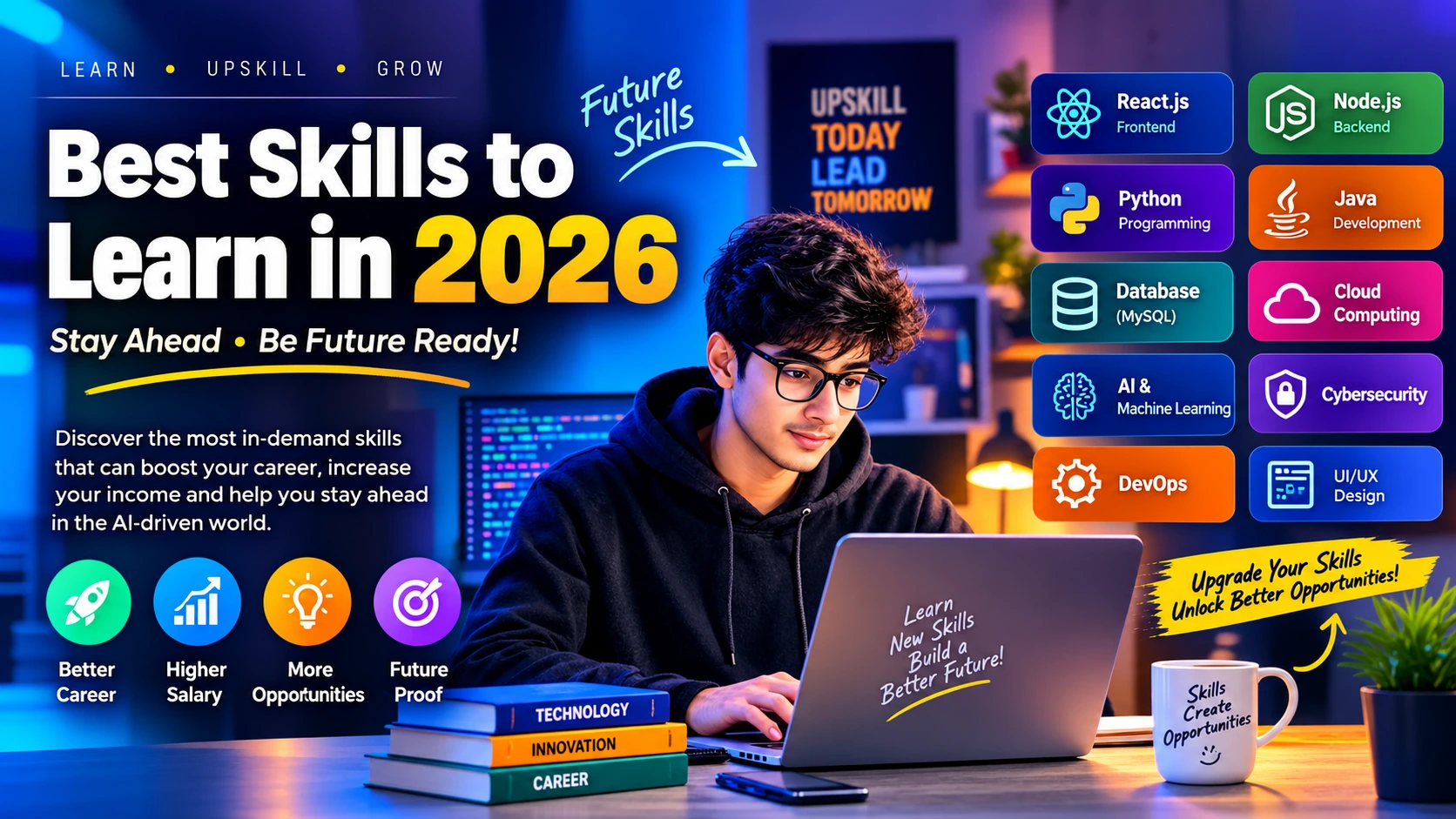
Discover the top 15 in-demand skills for 2026, including AI literacy, programming, data analysis, and cybersecurity to future-proof your career and boost employability.
Article Quick Highlights
- Global Career Focus: 15 high-impact skills evaluated across tech, business, and remote workplaces.
- Dual-Track Growth: Combining AI literacy with domain expertise creates the most resilient career profile.
- Zero-Cost Pathways: Practical ways to build in-demand skills using open-source tools and public projects.
- Actionable Execution: A structured 90-day learning blueprint designed to build real-world portfolio proof.
- Complete FAQ Guide: Answers to key questions about future jobs, student priorities, and remote careers.
The global job market is changing faster than ever. Artificial intelligence is rapidly integrating into everyday office workflows. Companies worldwide are adopting new automated systems and cloud infrastructure. Consequently, hiring managers prioritize professionals who can learn, adapt, and solve real problems over those who merely hold passive credentials.
Whether you are a student, recent graduate, working professional, career switcher, or remote job seeker, mastering the right skills in 2026 can unlock substantial career growth and long-term security. But with so many trends competing for attention, which capabilities are truly worth your time and effort?
In this comprehensive guide, we explore the 15 best skills to learn in 2026. From technical competencies like AI literacy, cloud engineering, and cybersecurity to durable human capabilities like critical problem-solving and persuasive communication, these skills are built to endure technological disruption.
Top 15 In-Demand Skills for 2026
Here is our curated index of future-proof skills poised to deliver high returns on effort in 2026 and beyond:
- Artificial Intelligence & AI Literacy
- Data Analysis & Business Intelligence
- Cybersecurity & Digital Defense
- Programming & Software Engineering
- Digital Marketing & Growth Strategy
- Cloud Computing & DevOps Basics
- High-Impact Communication Skills
- Critical Thinking & Complex Problem-Solving
- Applied Financial Literacy
- Modern Project Management & Agile Systems
- Digital Content Creation & Media Production
- UX/UI Product Design
- Global English & Multilingual Fluency
- Sales, Pitching & Negotiation
- Adaptability & Continuous Learning Velocity
Golden Career Rule for 2026: You do not need to master every item on this list. Building deep proficiency in two or three complementary skill sets is far more valuable than collecting superficial introductory certificates.
1. Artificial Intelligence and AI Literacy
Artificial intelligence is no longer speculative technology; it is standard operating infrastructure across industries. However, you do not need a computer science degree or deep mathematical background to benefit from it. For most professionals, AI literacy means understanding how modern AI models operate, recognizing their limitations, and using them responsibly to accelerate everyday work.
Students can use AI for structured research, complex topic summaries, and study planning. Meanwhile, professionals leverage generative tools for automated reporting, code review, marketing ideation, and workflow optimization.
Core Sub-Skills to Master
- Generative AI Principles: Understanding large language models, multimodal tools, and diffusion networks.
- Prompt Engineering & Context Design: Crafting clear instructions, role parameters, and system prompts to extract precise outputs.
- AI Automation & Agents: Connecting models to APIs, webhooks, and automation platforms to eliminate repetitive tasks.
- Fact-Checking & Hallucination Auditing: Verifying AI citations, data accuracy, and mathematical validity before final publishing.
- AI Ethics & Data Privacy: Guarding intellectual property and adhering to data governance standards.
2. Data Analysis & Business Intelligence
Modern enterprises accumulate vast oceans of data every hour. Raw data alone, however, provides zero value unless knowledgeable people can interpret trends, filter noise, and extract actionable decisions. That is why data analysis consistently ranks among the most resilient careers globally.
Every department—including marketing, operations, logistics, human resources, and product development—now relies on data-driven metrics. Starting your data journey does not require advanced programming; you can begin with spreadsheets and progressively expand your toolkit.
Core Sub-Skills to Master
- Advanced Spreadsheets: Google Sheets and Microsoft Excel (pivot tables, lookup functions, logic formulas, data models).
- Structured Query Language (SQL): Querying relational databases, aggregating large datasets, and joining tables.
- Data Visualization: Building intuitive executive dashboards in Power BI, Tableau, or Metabase.
- Applied Business Statistics: Understanding mean, variance, correlation, statistical significance, and hypothesis testing.
- Python for Analytics: Basic manipulation with Pandas, NumPy, and Matplotlib.
3. Cybersecurity & Information Defense
As global commerce, public infrastructure, and sensitive consumer data migrate to cloud architectures, cyber defense has become a mission-critical priority. Threat actors continuously evolve their tactics, making qualified cybersecurity specialists indispensable.
For individuals with analytical curiosity and a knack for structured investigation, cybersecurity offers strong compensation and high job security across private and government sectors.
Beginner Cybersecurity Roadmap
- Computer Networking Fundamentals: TCP/IP, DNS, OSI model layers, subnets, routers, and firewalls.
- Identity & Access Management (IAM): Multi-factor authentication, public key infrastructure (PKI), and zero-trust principles.
- Operating System Security: Linux command-line administration, permission hardening, and Windows event logs.
- Vulnerability Management: Common vulnerabilities and exposures (CVEs), patch workflows, and threat modeling.
4. Programming & Software Development
Coding remains the quintessential digital superpower. You do not need to become a full-time software architect to benefit from programming. Basic coding knowledge enables you to script automations, interact with web APIs, scrape public datasets, and build custom web tools.
For complete beginners, Python is widely recommended due to its natural syntax and unmatched dominance in data science, automation, and AI. For web builders, the JavaScript and TypeScript ecosystem remains the uncontested engine of modern internet applications.
High-Yield Technologies to Learn
- Python: Scripting, backend microservices, data processing, and automation.
- TypeScript / JavaScript: Modern frontend interfaces, Node.js servers, and serverless edge functions.
- Git Version Control: Branching, pull requests, resolving merge conflicts, and collaborative GitHub workflows.
- REST & GraphQL APIs: Integrating third-party services and exchanging structured JSON payloads.
5. Digital Marketing & Performance Growth
Creating an exceptional product or service is meaningless if nobody knows it exists. Organizations of every size require professionals who understand digital customer acquisition, organic search visibility, and retention funnels.
Modern digital marketing extends far beyond simply posting photos on social media. It combines data psychology, search algorithms, persuasive copywriting, and paid campaign analytics into a measurable revenue driver.
High-Impact Marketing Disciplines
- Search Engine Optimization (SEO): Technical search hygiene, search intent matching, on-page optimization, and authoritative backlink acquisition.
- Direct-Response Copywriting: Crafting headlines, landing page copy, and email sequences that compel action.
- Paid Acquisition: Running and optimizing campaigns on Google Ads, Meta Ads, and LinkedIn.
- Conversion Rate Optimization (CRO): Conducting A/B split tests, evaluating heatmaps, and streamlining signup flows.
6. Cloud Computing & Cloud Infrastructure
Almost every software application, mobile app, and database now runs on remote cloud environments. Understanding how cloud architectures deploy, scale, and secure resources is essential for IT professionals, developers, and data engineers alike.
The global cloud landscape is led by three dominant platforms: Amazon Web Services (AWS), Microsoft Azure, and Google Cloud Platform (GCP). Foundational concepts translate seamlessly between all three.
Core Cloud Competencies
- Compute & Virtualization: Deploying virtual instances, serverless functions, and container runtimes (Docker).
- Object & Block Storage: Managing scalable cloud storage buckets, lifecycle policies, and file systems.
- Cloud Networking: Configuring Virtual Private Clouds (VPCs), security groups, subnets, and load balancers.
- Cost Optimization: Monitoring usage metrics, reserving capacity, and preventing accidental resource drain.
7. High-Impact Communication Skills
Technical brilliance alone rarely guarantees career velocity. In distributed teams and competitive corporate environments, the ability to synthesize complex ideas, write clearly, and listen actively is often the deciding factor in promotions and leadership selections.
Effective communicators reduce friction, align stakeholders, and turn raw technical data into executive-level narratives that drive decisive action.
Essential Communication Facets
- Concise Business Writing: Drafting clear executive briefs, documentation, and action-oriented emails.
- Asynchronous Collaboration: Communicating effectively across global time zones using Slack, Jira, and shared docs.
- Structured Presentations: Delivering engaging slide decks with narrative pacing and clear takeaways.
- Active Listening: Asking probing clarifying questions before proposing solutions.
8. Critical Thinking & Complex Problem-Solving
While AI models generate immediate suggestions, human discernment is still required to determine whether those suggestions make sense, align with strategic goals, and obey ethical standards. Critical thinkers question assumptions, identify systemic bottlenecks, and design robust solutions.
- Precisely define the core challenge (avoid confusing symptoms with causes).
- Collect objective data from primary stakeholders.
- Separate factual data from unverified assumptions.
- Formulate multiple distinct solution hypotheses.
- Evaluate trade-offs, edge cases, and second-order consequences.
- Execute a controlled test implementation.
- Measure outcomes against baseline metrics and iterate.
9. Applied Financial Literacy
Whether you are a university graduate receiving your first paycheck or a seasoned professional planning long-term investments, financial literacy determines whether your hard work translates into enduring security and peace of mind.
Understanding basic economic mechanics also makes you a more effective business contributor, helping you understand company profit margins, budgeting trade-offs, and capital allocation.
Foundational Financial Competencies
- Cash Flow Management: Designing a dependable monthly budget and funding an emergency buffer.
- Debt Strategy & Credit: Managing credit utilization, minimizing high-interest liabilities, and protecting your credit score.
- Index Investing & Compounding: Understanding broad-market index funds, ETFs, asset diversification, and time horizons.
- Tax Planning & Deductions: Understanding tax brackets, retirement contributions, and legal write-offs.
10. Modern Project Management & Agile Systems
Project management is not restricted to people holding the official title of Project Manager. Freelancers, software engineers, marketing leads, and startup founders all must juggle deadlines, prevent scope creep, and coordinate resources.
Understanding modern project frameworks ensures you deliver complex initiatives on schedule without burning out yourself or your team.
Core Project Management Topics
- Agile & Scrum Methodologies: Sprints, daily standups, backlog refinement, and retrospectives.
- Scope & Dependency Mapping: Identifying critical paths and anticipating project blockers before they happen.
- Tool Proficiency: Structuring workspaces in tools like Jira, Linear, Trello, Asana, and Notion.
- Risk Mitigation: Drafting contingency plans for unexpected supplier delays or technical failures.
11. Digital Content Creation & Media Production
The modern digital economy rewards creators who can articulate valuable perspectives through video, audio, visual design, and written prose. Companies are steadily shifting recruitment toward candidates who have demonstrated public thought leadership.
While AI tools can assist with script drafts and editing, human storytelling, personal authenticity, and genuine expertise remain irreplaceable.
High-Demand Creative Formats
- Short-Form Video Production: Scripting, filming, and pacing content for YouTube Shorts, Reels, and TikTok.
- Long-Form Technical Writing: Publishing thorough tutorials, whitepapers, and industry deep-dives.
- Podcasting & Audio Engineering: Conducting insightful interviews and editing crisp vocal tracks.
- Newsletter Publishing: Building an owned audience through weekly curated email publications.
12. UX/UI Product Design
Software applications only succeed if target users can easily navigate them to accomplish their goals. UX (User Experience) and UI (User Interface) design bridge human psychology, graphic aesthetics, and technical feasibility.
Skilled designers conduct qualitative user interviews, prototype wireframes, and translate product requirements into accessible, beautiful digital interfaces.
Core Design Capabilities
- Figma Mastery: Auto-layout, components, interactive prototypes, and design systems.
- User Research & Testing: Synthesizing customer feedback and conducting usability sessions.
- Information Architecture: Structuring page hierarchies, navigational trees, and checkout flows.
- Web Accessibility (WCAG): Designing with high-contrast ratios, readable typography, and screen-reader accessibility.
13. Global English & Multilingual Fluency
English remains the lingua franca of global commerce, software development, academic research, and international remote teams. Refining your spoken and written fluency immediately expands your potential client and employment pool beyond regional borders.
Furthermore, learning a strategic second language—such as Spanish, German, Japanese, or Mandarin—can create unique cross-border trade, translation, and diplomatic opportunities.
Targeted Improvement Areas
- Professional Email & Slack Etiquette: Avoiding ambiguous tone and writing courteous, actionable notes.
- Interview & Presentation Fluency: Articulating past achievements and problem-solving examples with clarity.
- Cross-Cultural Nuance: Adapting communication styles when working with international colleagues.
14. Sales, Pitching & Negotiation
Sales skills are not only for retail representatives or corporate account executives. Every professional continually pitches ideas to team leads, negotiates compensation packages, or persuades clients to approve proposals.
Persuasion is grounded in empathy: diagnosing another party's unfulfilled needs and aligning your proposal to solve their exact pain points.
Valuable Negotiation Capabilities
- Consultative Discovery: Uncovering hidden client objections through targeted open-ended questions.
- Value-Based Framing: Communicating your solution in terms of return on investment (ROI) rather than feature lists.
- Salary Negotiation: Grounding compensation requests in market benchmark data and measurable accomplishments.
- Conflict Resolution: Finding mutually beneficial compromises without damaging professional partnerships.
15. Adaptability & Meta-Learning
Perhaps the single most critical capability of all is meta-learning—the skill of learning new skills quickly. Technological frameworks, market demands, and company tools will inevitably shift every two to three years. A static skill set quickly becomes obsolete.
Instead of wondering what single skill will protect your career forever, cultivate deliberate habits that allow you to master new disciplines on demand:
- Daily Intellectual Curiosity: Read specialized industry newsletters and academic whitepapers for 30 minutes daily.
- Aggressive Project-Based Practice: Immediately build small applications or mock campaigns to test new theoretical concepts.
- Feedback Loops: Seek constructive criticism from seasoned mentors to rapidly diagnose blind spots.
- Embracing Discomfort: View initial beginner confusion as normal cognitive friction rather than inadequacy.
Skill Matrix: Which Skills Match Your Career Goals?
Use the matrix below to align your personal career ambitions with high-leverage skill combinations:
| Target Career Goal | Primary Recommended Skill Stack | Key Complementary Skill |
|---|---|---|
| AI & Machine Learning | Python, Linear Algebra, PyTorch, Prompt Design | Data Cleaning & SQL |
| Data Analytics | SQL, Excel/Sheets, Power BI, Statistics | Business Presentation & Storytelling |
| Cybersecurity Specialist | Linux Admin, Networking (TCP/IP), IAM, CVE Analysis | Python Scripting |
| Software Engineer | JavaScript/TypeScript, React/Next.js, Git, APIs | Cloud Infrastructure (AWS/Docker) |
| Digital Marketing Growth | Technical SEO, Paid Ads, Copywriting, Google Analytics | AI-Driven Content Automation |
| Remote International Roles | Asynchronous Communication, English Fluency, Slack/Notion | Specialized Domain Skill (Coding/Design/Writing) |
| Tech Entrepreneurship | Direct Sales, Product Validation, Cashflow Budgeting | No-Code Prototyping & Generative AI |
| Student Foundation | AI Literacy, Professional Writing, Personal Finance | Spreadsheets & Basic Coding |
How to Learn High-Income Skills for Free in 2026
You do not need an expensive bootcamp or a five-figure postgraduate certificate to acquire career-defining capabilities. Nearly every technical and digital discipline offers world-class educational material online for free—provided you follow a disciplined curriculum.
For verified free certification programs from Google, Harvard, and Microsoft, explore our curated breakdown of 11 high-value free certifications to dominate the job market.
The Practice-Over-Theory Principle
The single most common mistake beginners make is falling into tutorial paralysis—passively watching videos without writing a line of code or designing a real dashboard. To guarantee skill retention:
- If you study SQL, download an open Kaggle dataset and answer real-world business queries.
- If you study SEO, launch a niche blog and optimize its technical architecture to rank on Google.
- If you study UI/UX Design, redesign an existing clumsy mobile app interface and document your design decisions in a public case study.
5 Decision Filters: How to Choose Your Next Skill
When confronted with dozens of exciting options, use these five systematic filters to eliminate analysis paralysis:
1. Genuine Baseline Interest
Learning any meaningful skill involves cognitive strain. If you choose a skill solely for its salary prospects while dreading the actual daily workflow, you will likely abandon it within three weeks.
2. Clear Career Application
Never learn a skill in an arbitrary vacuum. Define the exact job description, freelance service, or company project where you will deploy it within the next six months.
3. Verifiable Proof of Work
Can you produce a tangible portfolio artifact demonstrating your competence? Employers increasingly value live GitHub repositories, published articles, and operational dashboards over resume bullet points.
4. Skill-Stacking Complementarity
The most distinctive professionals combine two diverse domains. For instance, pairing Healthcare Knowledge + Data Analytics or Civil Engineering + 3D Modeling makes you far more competitive than someone with generic skills alone.
5. Technological Longevity
Prioritize foundational principles over ephemeral tools. For example, learning the core logic of relational databases will serve you for decades, regardless of which specific database platform surges in popularity next year.
A Practical 90-Day Skill Mastery Blueprint
Do not attempt to overhaul your entire career in a weekend. Commit to 45–60 minutes of uninterrupted daily practice following this three-phase timeline:
Foundation & Concepts
Pick one primary skill. Complete one structured beginner course or official documentation track. Take thorough notes and build mini-exercises daily.
Practical Sandbox Projects
Abandon tutorials entirely. Build two independent, end-to-end sandbox projects from scratch without following guided step-by-step videos.
Portfolio & Public Proof
Refine your projects, write detailed case studies, polish documentation, and publish your work on GitHub, Behance, or a personal website.
AI vs. Traditional Domain Skills: The Hybrid Advantage
Job seekers frequently ask: "Should I abandon my traditional degree or career to become an AI engineer?"
The answer is almost always no. The greatest career leverage in 2026 belongs to professionals who adopt a Hybrid Strategy: fusing deep domain expertise with AI augmentation.
Winning Hybrid Combinations in the Market:
- Marketing Strategy + Generative AI: Producing hyper-personalized customer campaigns at scale.
- Finance & Accounting + Automated Data Pipelines: Reducing monthly reconciliation cycles from days to minutes.
- Human Resources + People Analytics: Forecasting turnover risks and optimizing recruitment funnels.
- Software Development + AI Pair Programming: Shipping reliable features twice as fast with AI unit testing.
Frequently Asked Questions (FAQ)
What are the absolute best skills to learn in 2026?
The top skills in 2026 span technical and durable disciplines: AI literacy, data analysis, cybersecurity, cloud architecture, and programming lead technical fields, while critical thinking, persuasive communication, and project management provide lifelong career durability.
Which skill offers the highest future resilience against automation?
Skills combining strategic reasoning, emotional intelligence, and cross-disciplinary synthesis are the most resilient. Roles requiring negotiation, stakeholder consensus, complex troubleshooting, and creative vision cannot be automated by algorithms alone.
Can I genuinely learn high-paying skills for free?
Yes. Millions of professionals have learned software engineering, data analytics, and SEO using open-source documentation, free university lectures (e.g., Harvard CS50, MIT OpenCourseWare), and community platforms. The critical requirement is building verifiable projects.
What are the most valuable skills for college students?
Students should focus on mastering AI literacy, structured research, public speaking, business spreadsheet modeling, and basic coding. Pairing these with practical internships provides an immense edge over peer graduates.
Which skills are best suited for landing remote work?
Remote employers prioritize candidates with proven asynchronous communication skills, self-directed time management, documentation rigor, and portable technical abilities like software development, digital marketing, UX design, or data analytics.
Do I need advanced math to work in AI?
To train foundational deep learning architectures from scratch, advanced calculus and linear algebra are necessary. However, for 90% of business and technical roles, you only need AI literacy—knowing how to connect APIs, orchestrate workflows, and engineer effective prompts.
How many skills should I study at the same time?
Focus on one primary technical skill and one complementary soft skill at a time. Juggling multiple disparate subjects leads to cognitive fatigue and shallow comprehension.
Final Career Perspective for 2026
The best skill to learn in 2026 is rarely the one with the flashiest marketing slogan. The most powerful skill is one that you can consistently practice, tangibly demonstrate, and continually refine.
When you merge modern digital literacy with foundational problem-solving and proactive communication, you build a recession-proof career that thrives through every technological shift.
Stay curious, select your focus skill today, and begin building. If you are actively seeking career openings, explore verified opportunities on our RozgarRank Latest Jobs Portal.