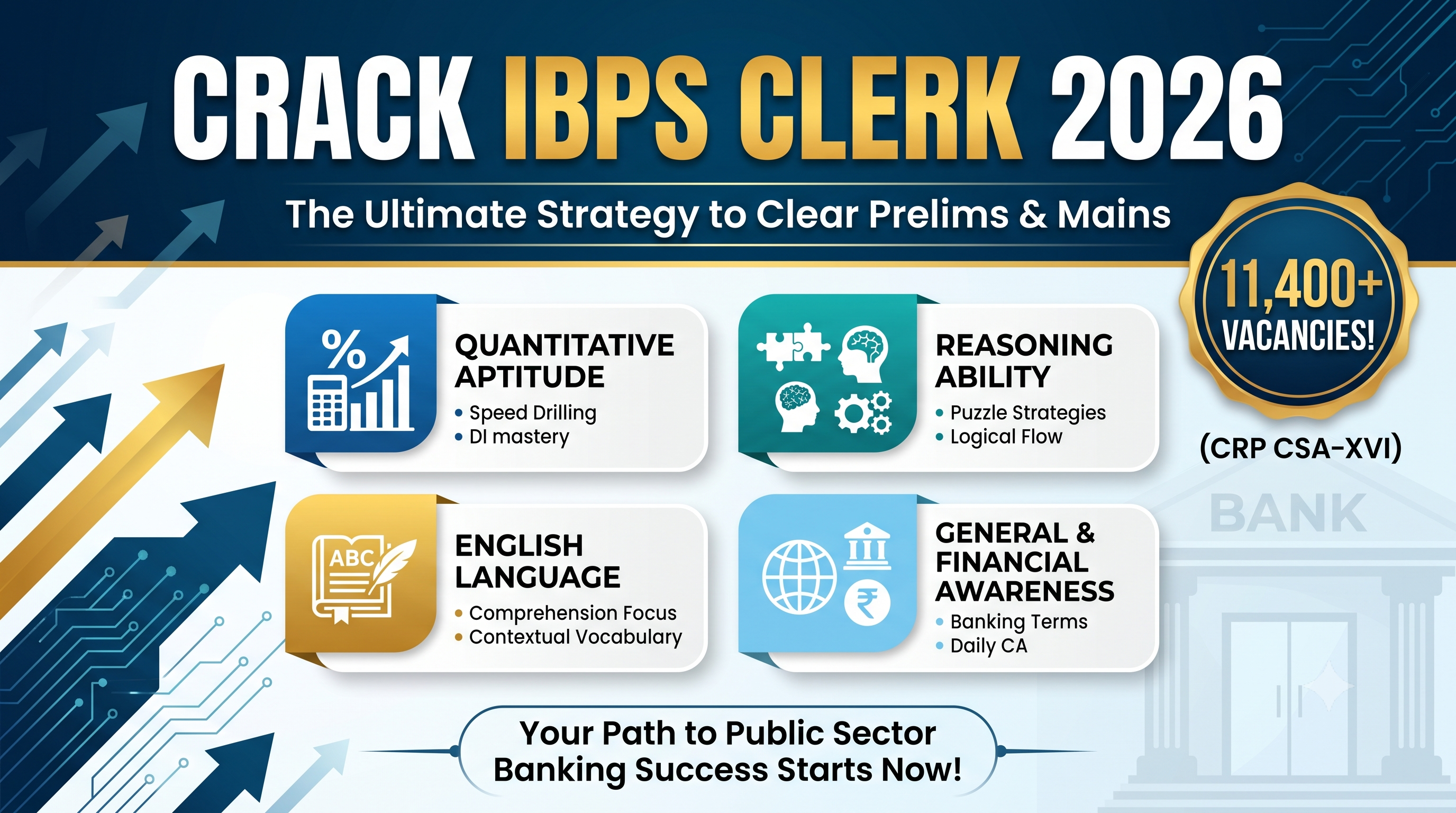
Master the IBPS Clerk 2026 (CRP CSA-XVI) exam with our comprehensive 60-day preparation strategy. Learn section-wise tips for Quantitative Aptitude, Reasoning, English, General Awareness, and smart mock test analysis techniques to clear Prelims & Mains in your first attempt.
With the IBPS Clerk 2026 (CRP CSA-XVI) notification out and over 11,400 vacancies up for grabs, the race for a Public Sector Bank job is officially on.
Many aspirants fail bank exams not because they lack knowledge, but because they lack speed, accuracy, and strategy. Unlike university exams, banking exams are a test of time management and nervous system control under pressure.
Whether you are a first-time aspirant or looking to improve your previous score, this comprehensive guide breaks down the exact section-wise preparation strategy you need to clear the IBPS Clerk exam in 2026.
1. Decoding the Exam: Speed (Prelims) vs. Endurance (Mains)
Before diving into books, you must understand the rules of the game. The IBPS Clerk selection process is divided into two major online stages, followed by a Local Language Proficiency Test (LLPT).
Prelims vs. Mains: Quick Comparison Table
| Feature | Preliminary Exam | Main Exam |
|---|---|---|
| Primary Objective | Speed & Accuracy (Screening Test) | Conceptual Depth & Stamina (Merit Decider) |
| Total Questions | 100 Questions | 160 Questions |
| Total Marks | 100 Marks | 200 Marks |
| Total Duration | 60 Minutes (20 min/section) | 125 Minutes (Sectional timing applies) |
| Negative Marking | 0.25 marks per wrong answer | 0.25 marks per wrong answer |
| Final Merit Impact | Qualifying only (Marks NOT counted) | 100% weightage for final selection |
2. Section-Wise Master Strategy
A. Quantitative Aptitude: Winning the Numbers Game
Quantitative Aptitude is often the most dreaded section, but it is also the most scoring if you follow a structured hierarchy. Do not waste time trying to solve every question chronologically.
High-Yield Topic Priority
Tier 1: The Quick Scorers (Aim for 100% Accuracy here first)
- Simplification & Approximation: Master BODMAS, squares up to 40, cubes up to 20, and percentage-to-fraction conversions (1/2 to 1/20).
- Number Series (Missing & Wrong): Practice 20 series daily to train your eyes to spot patterns — differences, prime numbers, multiplication + addition — instantly.
- Quadratic Equations: Learn the sign-method shortcuts to solve roots in under 30 seconds without writing long quadratic formulas.
Tier 2: Data Interpretation (DI)
- Focus on Tabular, Bar Graph, and Line Chart DI for Prelims.
- Improve your mental calculation speed for averages, ratios, and percentage differences — most DI questions revolve around these three operations.
Tier 3: Arithmetic (Word Problems)
- Do not try to master all 15 arithmetic chapters at once. Handpick your strongest 6–8 topics.
- Must-Do Chapters: Percentages, Ratio & Proportion, Profit & Loss, Averages, and Time, Speed & Distance (master ratio-based shortcut methods for train and platform problems to avoid long algebraic equations).
B. Reasoning Ability: The Score Booster
Reasoning is about logical clarity and stress management. The golden rule here is: Never get emotionally attached to a puzzle.
How to Attack the Reasoning Section
First 8 Minutes (Grab Easy Marks):
- Syllogisms: Use clean Venn diagram methods. Pay special attention to "Only a few" and "Possibility" cases.
- Inequalities: Score 5 marks in under 2 minutes using open-door/closed-door visual tricks.
- Alphanumeric / Symbol Series: Read the question carefully (e.g., "to the left of the 5th element from the right") to avoid silly mistakes.
- Blood Relations & Direction Sense: Draw clear family trees and compass grids.
Next 12 Minutes (Conquer the Puzzles):
- Attempt Seating Arrangements (Linear/Circular) and Scheduling Puzzles (Floor/Day/Month based).
- Golden Rule: Always read the puzzle twice before drawing. If a puzzle does not start coming together within 3 minutes, drop it immediately and move on.
C. English Language: Reading Over Rote Grammar
Gone are the days when cramming 100 grammar rules could clear banking exams. Today's IBPS English section tests contextual comprehension and reading speed.
3-Step English Strategy
Step 1: Master Reading Comprehension (RC)
- Read one financial or analytical editorial daily (e.g., The Hindu or LiveMint).
- Focus on tone, central theme, and vocabulary-in-context questions.
Step 2: Cloze Test & Para Jumbles
- For Cloze Tests, read the entire paragraph once before looking at the options — understand the tone (positive/negative) first.
- For Para Jumbles, look for mandatory pairs (e.g., a pronoun in sentence C referring to a noun introduced in sentence A).
Step 3: Error Spotting
- Focus on high-frequency grammar rules: Subject-Verb Agreement, Tenses, Prepositions, and Conditional Sentences.
D. General & Financial Awareness (Mains Only)
Do not wait until Prelims results are declared to start General Awareness (GA). This section is the ultimate game-changer that pushes your score above the final selection cut-off.
| Category | Weightage | What to Cover |
|---|---|---|
| Current Affairs | ~40% | Last 4–6 months of current events. Focus on Banking news, RBI circulars, national schemes, appointments, and summits. |
| Static Banking Awareness | ~40% | Core banking terminology — Repo Rate, CRR, SLR, NPA, Types of Bank Accounts, Negotiable Instruments, and Priority Sector Lending (PSL). |
| Static GK | ~20% | National Parks, Wildlife Sanctuaries, HQs of International/Financial Organizations, and Important Days. |
3. The "1:2 Rule" for Mock Test Analysis
Taking a mock test is only 33% of the work; analyzing it is the remaining 67%. Follow the 1:2 Rule: For every 1 hour you spend attempting a mock test, spend 2 hours analyzing it.
How to Review Your Mock Tests
- Unattempted Questions: Why did you skip them? Was it lack of conceptual clarity or a time shortage?
- Incorrect Answers: Identify the root cause. Was it a calculation blunder, a misread question, or a flawed concept?
- Correct Answers (Slow Time): Did you take 3 minutes to solve an arithmetic problem that could have been solved in 45 seconds using a ratio trick? Find the faster approach.
The goal of mock analysis is not just to find what you got wrong — it's to find what you could have done better, faster, and smarter.
4. Daily Preparation Schedule (60-Day Blueprint)
Here is a structured daily schedule that covers all sections systematically over a 60-day preparation window:
| Time Slot | Activity | Focus Area |
|---|---|---|
| Morning (1.5 Hours) | Current Affairs & Reading | Daily CA notes + 1 Editorial Reading |
| Mid-Day (2 Hours) | Quantitative Aptitude | 30 min Simplification/Series drills + 1.5 hrs Chapter concepts |
| Evening (2 Hours) | Reasoning Ability | 4 Daily Puzzles + 30 min Miscellaneous topics (Syllogisms/Inequalities) |
| Night (1.5 Hours) | English & Revision | Sectional quizzes + Vocab review + Formula revision |
| Weekends | Testing & Analysis | Take 1 Full-Length Timed Mock Test + Conduct Deep-Dive Analysis |
Summary Checklist for Aspirants
- ✅ Download and read the official IBPS Clerk notification carefully.
- ✅ Verify your eligibility and apply early to avoid last-minute server rushes.
- ✅ Start daily editorial reading to build English speed and analytical focus.
- ✅ Practice at least 4 reasoning puzzles and 20 calculation drills every single day.
- ✅ Dedicate 30 minutes daily to Current Affairs from Day 1 — do not delay until Mains.
👉 Join RozgarRank on Telegram
👉 Follow RozgarRank on Instagram
The IBPS Clerk exam rewards those who prepare smart, not just hard. With the right strategy, consistent daily practice, and honest mock test analysis, clearing the exam in your first attempt is absolutely achievable.
Your government bank job journey starts today. Make every day count. 💪